Watch the video at the end of this article.
Introduction
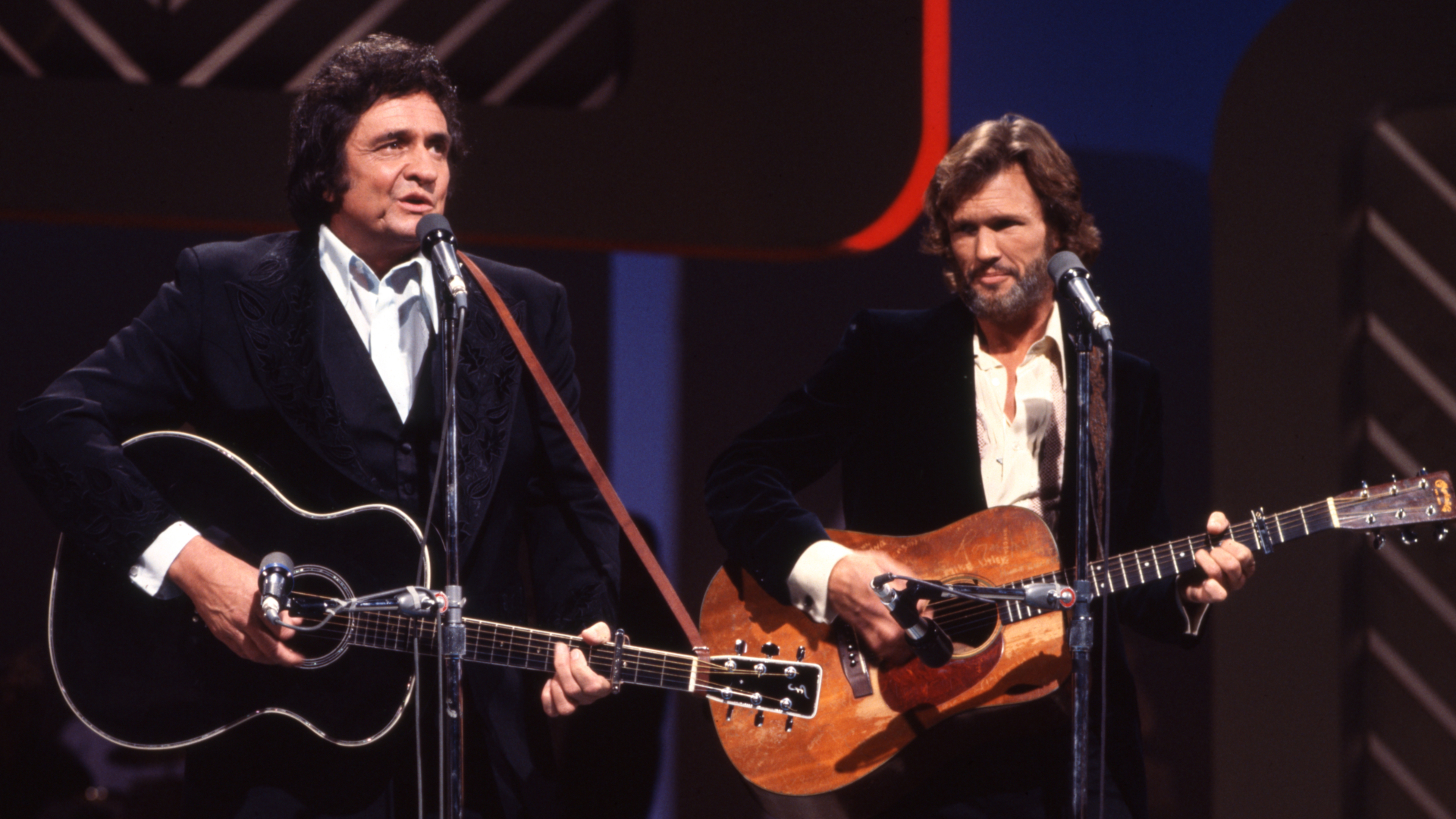
In the rich landscape of American country music, few collaborations feel as naturally powerful and spiritually aligned as the imagined meeting of two legendary figures performing “Big River,” a song deeply rooted in the tradition of storytelling and emotional truth. In this reinterpreted performance of the classic originally written and recorded by Johnny Cash, the stage becomes more than a musical setting—it transforms into a symbolic crossing point between two artistic souls who have each, in their own way, defined the meaning of honesty in song.
When joined by Kris Kristofferson, the performance takes on an entirely new dimension, blending Cash’s grounded, rhythmic authority with Kristofferson’s poetic introspection, creating a version of “Big River” that feels both timeless and newly alive. The song itself tells the story of a man pursuing lost love along the winding path of the Mississippi River, a journey filled with hope, regret, and the painful realization that not everything meant to be held onto can actually be reclaimed.
In the hands of Cash, this narrative becomes a lived experience rather than a simple lyric; his deep, resonant voice carries the weight of someone who has walked that riverbank in spirit countless times. Every line feels deliberate, measured, and carved from experience, as if the river itself is speaking through him. When Kristofferson enters this musical dialogue, the energy shifts subtly but profoundly. His vocal tone, weathered and reflective, adds a layer of philosophical depth, turning the pursuit of lost love into a broader meditation on time, memory, and the roads we choose to travel. Together, they do not simply perform “Big River”—they inhabit it, allowing its currents to flow through their contrasting but complementary styles. The Mississippi becomes more than a setting; it becomes a metaphor for life’s unstoppable motion, carrying both men and listener alike through scenes of longing, discovery, and acceptance.
As the performance unfolds, the interplay between Cash’s steady gravity and Kristofferson’s wandering introspection creates a dynamic tension that feels almost cinematic. One voice anchors the song in earth and dust, while the other lifts it into reflection and contemplation, and somewhere between them, the true heart of the story emerges. It is not merely about chasing love, but about understanding the limits of pursuit itself, and recognizing that some journeys are meant to teach rather than to conclude in triumph. In this imagined collaboration, “Big River” becomes a gathering point for the entire tradition of country storytelling—where hardship is not hidden, emotion is not softened, and truth is always delivered with unflinching clarity.
The performance stands as a reminder that country music at its best is not just entertainment, but a form of oral history, carried forward by voices that refuse to separate beauty from pain. By the final notes, what remains is not just the memory of a song, but the impression of two masters standing on the same current, allowing it to carry their stories downstream together, united in the understanding that the river never stops, and neither does the human heart searching within it.
Video