Watch the video at the end of this article.
Introduction
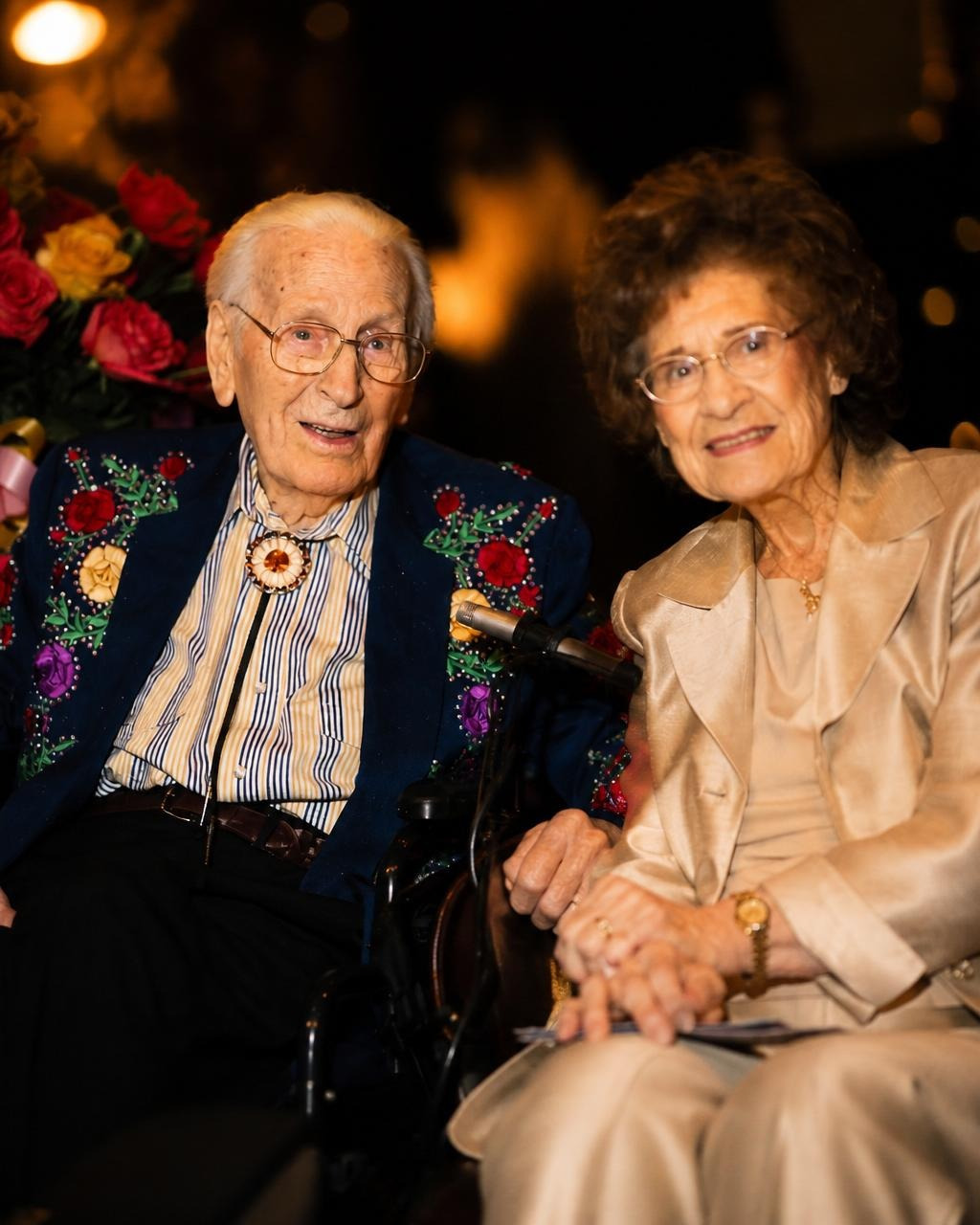
On a quiet evening that felt suspended between memory and music, there was a moment on Country’s Family Reunion that seemed to hold an entire lifetime inside it. Kitty Wells, already a living legend in country music, stood gently in front of the microphone and sang “Dust on the Bible” with a calmness that came only from decades of faith, struggle, and devotion to her craft. Beside her, seated just a few feet away, was Johnnie Wright—the man she had married when she was only eighteen, the man who had shared nearly every chapter of her life since the late 1930s.
He did not speak. He did not move much at all. He simply watched her.
There was something profoundly still about the way he looked at her in that moment. It was not the gaze of a man observing a performer; it was the gaze of someone who had seen every version of her—before fame, before the awards, before history had written her name into the foundation of country music. It was the same kind of look he might have given her in 1937, when they were just teenagers in Nashville, long before either of them understood what their future would become.
By then, their lives had already carried the weight of extraordinary history. Kitty Wells had broken barriers that were never meant to be broken. In an era when women were told they could not sell country records, she proved the entire industry wrong. Her response to being underestimated was not anger, but music—songs that carried truth sharp enough to reshape the genre itself. When she released “It Wasn’t God Who Made Honky Tonk Angels” in 1952, she became the first woman in country music history to reach number one on the charts. That achievement opened a door that had been locked for generations. What followed were fourteen consecutive years of being voted the top female vocalist in country music, and a string of Top Ten hits that solidified her legacy as a pioneer.
But none of that seemed to exist in that particular moment on stage.
There were no charts, no awards, no headlines. There was only Kitty, standing in simple grace, singing a gospel song she had carried with her since 1959. And there was Johnnie, sitting close enough that if he had reached out, he could have touched her hand without effort. Yet he remained still, as if any movement might disturb the fragile purity of what was unfolding before him.
It was not admiration in the ordinary sense. It was recognition. A deep, wordless understanding of a life shared so completely that even silence became meaningful. The kind of connection that survives fame, hardship, aging, and time itself.
Years later, the story would close quietly. Johnnie Wright passed away in 2011. Only ten months after him, Kitty Wells followed. The stage lights dimmed, the songs remained, and the world moved forward. But that moment—the one where a husband simply watched his wife sing as if it were still 1937—remains suspended in time, untouched by everything that came after it.